
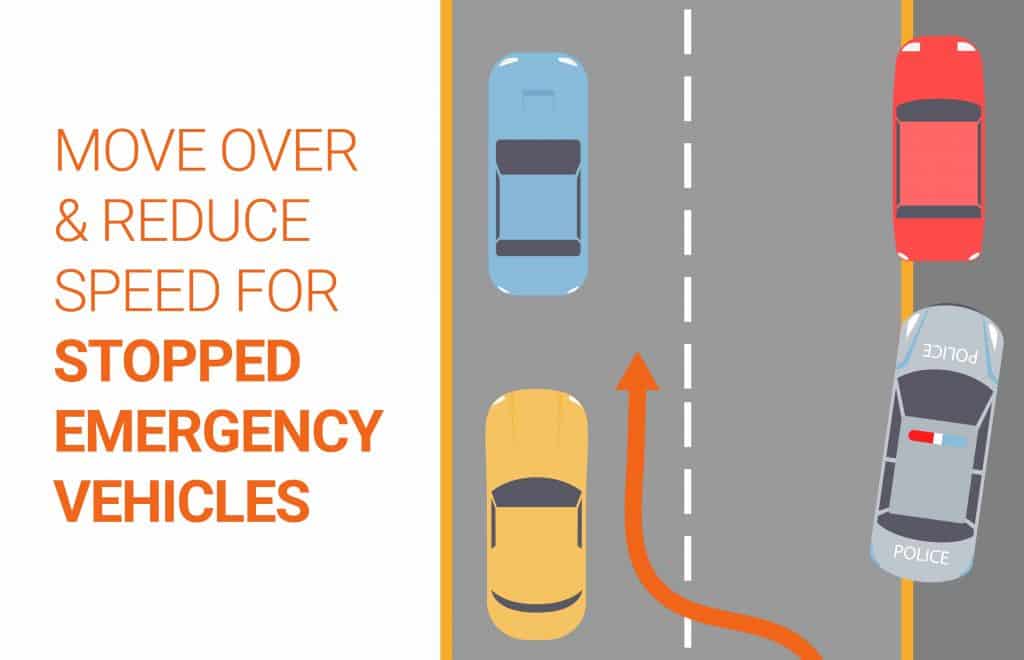
The New York Move Over Law requires drivers to be extra cautious when approaching an emergency or hazard vehicle that is stopped on the side of the road with its emergency lights on. Drivers are expected to move one full lane away from the stopped vehicle. If it is not possible to do so safely, then the driver must reduce speed as it approaches the stopped vehicle.
Specifically, the Move Over Law requires drivers to slow down and move over for police and emergency vehicles (including ambulance workers and firefighters), hazard vehicles like tow trucks that display amber lights, roadway construction crews, roadway maintenance crews, and sanitation vehicles.
NYS VTL 1144-a(a) should not be confused with VTL 1144(a) - Failure to yield to an emergency vehicle, which drivers can read more about here.
What Are the Penalties for New York’s Move Over Law?
Fines: A conviction for violating VTL 1144-a(a), New York’s Move Over Law, can result in a fine of up to $150 for a first offense. A second offense within 18 months of the first means a fine of up to $300. A third offense within 18 months means a fine of up to $450.
Points: New York’s Move Over Law is a 2-point offense.
Surcharges: Like most moving violations in New York, drivers are obligated to pay a state surcharge of $88 or $93 upon conviction for New York’s Move Over Law.
Driver Responsibility Assessment (DRA) fee: Receiving 6 points within 18 months requires drivers to pay an additional fine called the Driver Responsibility Assessment (DRA). This is separate from the fine and is paid directly to the DMV. A DRA costs $300 for the first six points. Each additional point adds another $75.
Auto insurance increase: New York’s Move Over Law is a moving violation and can have an impact on one’s insurance premiums. Studies have shown that a conviction for a moving violation can result in a hike in rates of up to 20%, sometimes more.
Important: Drivers who violate New York’s Move Over Law are often ticketed for other offenses, such as speeding or failure to yield.
What Is New York’s Move Over Law – VTL 1144-a(a)?
Every state in the nation (except D.C.) has a variation of the Move Over Law. In New York, the offense is formally called “failing to move over for emergency vehicles and hazard vehicles” and is codified in VTL 1144-a(a).
What New York drivers really need to know is the law applies if he/she is in an adjacent lane as well. Failing to move over, even from an adjacent lane could result in a violation of VTL 1144-a(a). New York State Police enforce the law “vigorously” and issue hundreds of tickets each year. Often (but not always), a driver who is stopped and ticketed for this will also be hit with other tickets such as:
- Failure to Yield the Right of Way (3 Points)
- Improper Passing (3 Points)
- Unsafe Lane Change (3 Points)
- Reckless Driving (5 Points)
- Speeding (3-11 points depending on the speed)
- Official Text of New York's Move-Over Law
New York Vehicle and Traffic Law (VTL) 1144-a (a).
Every operator of a motor vehicle shall exercise due care to avoid colliding with an authorized emergency vehicle which is parked, stopped or standing on the shoulder or any portion of such highway and such authorized emergency vehicle is displaying one or more red or combination red and white lights pursuant to the provisions of paragraph two of subdivision forty-one of section three hundred seventy-five of this chapter or is displaying one or more blue, combination blue and red or combination blue, red and white lights pursuant to the provisions of subparagraph b of paragraph four of subdivision forty-one of section three hundred seventy-five of this chapter. For operators of motor vehicles on parkways or controlled access highways, such due care shall include, but not be limited to, moving from a lane which contains or is immediately adjacent to the shoulder where such authorized emergency vehicle displaying one or more red, blue or white or any combination of red and white lights or blue or combination blue and red or combination blue, red and white lights pursuant to the provisions of paragraph two or subparagraph b of paragraph four, as applicable of subdivision forty-one of section three hundred seventy-five of this chapter is parked, stopped or standing to another lane, provided that such movement otherwise complies with the requirements of this chapter including, but not limited to, the provisions of sections eleven hundred ten of this title and eleven hundred twenty-eight of this title.
Notice: New York’s Move Over Law was enacted to protect police and other emergency workers. As such, police aggressively ticket those who violate it. More importantly, judges handling these cases are stricter for the same reason.
Common Defenses to the Move Over Law, VTL 1144-a(a)
There are a few potential defenses that a skilled attorney can use to help a driver get out of a Move Over Law ticket.
First, New York law prohibits a driver from moving over or changing lanes unless he or she first finds it safe to do so. Consequently, a driver’s first line of defense against a move over law ticket is to cite NY VTL 1128, which expresses this idea, and to explain how and why moving over would have been unsafe.
Remember, the wording of the unsafe lane change law (VTL 1128) reveals that the burden is on the driver to determine whether it would be safe to change lanes or not. In other words, this is not an objective standard that can be evaluated by the officer looking at what an objectively reasonable and prudent person would have done. This subjectivity gives a driver the upper hand and makes it harder for a prosecutor to say it would have been reasonable to move over.
Additionally, if it would have been safe for the driver to move over, but he/she simply did not have enough time to do so, this can be raised as a defense against a move over law ticket. This again requires an attorney to cite and explain NY VTL 1128. Second, if moving over would have forced the driver to cross over a double yellow line, then he/she cannot have been expected to do so and the ticket will not stand. After all, NY VTL 1110 requires drivers to obey traffic control devices. These include the laws pertaining to road markings, signs, and road lines
Ultimately, these two statutes, NY VTL 1128 and NY VTL 1110 can be one’s strongest arguments against a NY move over law ticket.

Need help with your move over law ticket?
Call Now - We've Fought Over 50,000 Traffic Ticket Cases
Quick, free, and no obligation.
Case Law Analysis
In the case of Despian v. Garcia, the Supreme Court of New York heard a case involving a Honda minivan and two police cars that were involved in a collision. The driver of the Honda minivan struck one of the patrol cars, which caused the patrol car to spin out of control and collide with a nearby unmarked police vehicle.
Although the court was mostly dealing with a civil case of negligence, the court brought forth an interesting piece of information concerning the Move Over Law.
Did you
know?


Kent Ng
Toward the end of the opinion, and after quoting the Move Over Law in full, the court explained that the driver “has not submitted any evidence that he took any of the actions required by section 1144 when he admittedly heard the siren and saw the lights of the approaching emergency vehicle.” Despian v. Garcia, 2013 NY Slip Op 30520 (Supreme Court 2013).
Afterward, the court ruled that the driver’s failure to bring forth this evidence showed that he could have been negligent in his actions.
For a New York driver, this is important. According to this case, those who fail to obey the Move Over Law can be found negligent. After all, failing to adhere to a traffic law could be grounds for the breach of a duty owed to other drivers. Presuming the driver caused damage or an injury to another person, he/she very well—like the driver in Despian—might be negligent.
What does this mean for most New York drivers? Be careful! For those who get a ticket for violating the VTL 1144, it is absolutely vital to:
- provide concrete evidence of how one, in actuality, complied with the statute (i.e. you did move over at the right time)
- provide a good defense for why it would have been dangerous or even unlawful to move over or hire an attorney to negotiate a settlement on your behalf (where available)
Despian v. Garcia is a clarion call for all New York drivers. It not only warns that violating the Move Over law can be enough to keep a negligence lawsuit alive, but also that traffic ticket violations can be used against in a different legal arena entirely: civil negligence cases.
Key Takeaways
- A driver is only obligated to move over if it is safe to do so.
- The burden is on the driver to determine whether or not it is safe, which gives drivers an advantage when defending against a Move Over Law ticket.
- A driver cannot cross a double yellow line to comply with the Move Over Law.
- If a driver cannot move to the left, then he or she is required to reduce speed.
New York Move Over Law Tickets and Out-of-State Drivers
Every state has its own variation of the Move Over Law. Out-of-state drivers who fail to move over while in New York will have to face the penalties of New York’s law (not those of their home state). It is also important that drivers realize that just because the ticket occurred out of state doesn’t mean it won’t affect them—most states share information about traffic ticket convictions.
That means a conviction is very likely to appear on one’s driving record regardless of where the ticket was issued. Remember: New York’s Move Over Law is a moving violation, so it can have a noticeable impact on one’s out-of-state auto insurance as well.
Read more out of state drivers with New York Traffic Tickets here
Common Questions About New York’s Move Over Law
- Does the Move Over Law apply just to police?
No. The statute covers any authorized emergency vehicle with one or more blue lights or a combination of red, blue, or white lights, as well as maintenance vehicles with amber lights.
- What vehicles do you have to move over for under VTL 1144-a(a)?
Drivers must do their best to slow down or move over for any emergency or maintenance vehicle. This includes:
- Law enforcement vehicles
- Fire department vehicles
- Ambulances
- Tow trucks or H.E.L.P. vehicles
- Garbage trucks
- Construction or other roadway work crews
- Do I have to move over if the vehicle does not have its emergency lights on?
While the statute states that a vehicle must be “displaying” its lights, it is a good habit to safely slow down and consider moving over any time there is a vehicle—even a non-emergency vehicle—on the side of the road.
- Is the Move Over Law the same as failing to yield to an emergency vehicle?
No. Failing to yield to an emergency vehicle (VTL 1144-a) is different. This applies when drivers do not give the right of way to a police, ambulance, or fire department vehicle that is approaching with its lights and/or siren on. The fine for this offense is higher ($275) and carries more points (3). The Move Over Law is a subdivision of statute 1144-a with its own distinct parameters and penalties.